The difficult truth is that thousands of brands and business owners wake up to a website that is underperforming with conversions. You may have spent months or even years, and a significant portion of your budget trying to build something that actually works. You’ve scoured the internet and hired the best copywriters and designers, but when you check your analytics, nothing is happening, and worse, the needle is dropping.
It’s easy to blame the copy or the visuals, and to think that the culprits are things we can see or touch. But, what if the reason visitors aren’t converting has nothing to do with how your site is expressed, and instead, everything to do with a fundamental misalignment that doesn’t show up in analytics?
In this guide, we aren't going to talk about button colors or headline tweaks. Instead, we are going to look at the "cracks in the foundation". We will explore why your analytics might be lying to you, why "best practices" often stall growth, and the three invisible questions every visitor asks within five seconds of landing on your page. By the end, you’ll understand why a diagnosis must always come before optimization if you ever want to achieve stable, exponential growth
The Misdiagnosis Most Teams Start With
There’s a moment in most companies when the upper management eventually reviews the performance of the website and notices an uncomfortable truth: conversions are dropping faster than Black Friday prices.
That’s the moment fingers start pointing in every direction, and usually it’s the creative team that gets the blame. Questions get thrown about like “Who approved this copy? It’s not persuasive enough!” or “Who designed this? It’s boring!”.
This usually happens because these are safe problems to fix. They are:
- Tangible
- Accessible
- Visible
- Actionable
It’s completely natural to want to begin here. There’s even a word for it: “Action Bias,” which The Decision Lab explains very well. It’s when you want to see progress over analysis, because with progress, it feels like you are doing something.
But, like most things in life, there is always a cost. And the hidden cost of starting with these “problems” is that you never learn why people are hesitating (conversion friction). Which likely means that no matter how many times you change the copy or tweak a design, those conversions are not going to increase exponentially in a stable way.
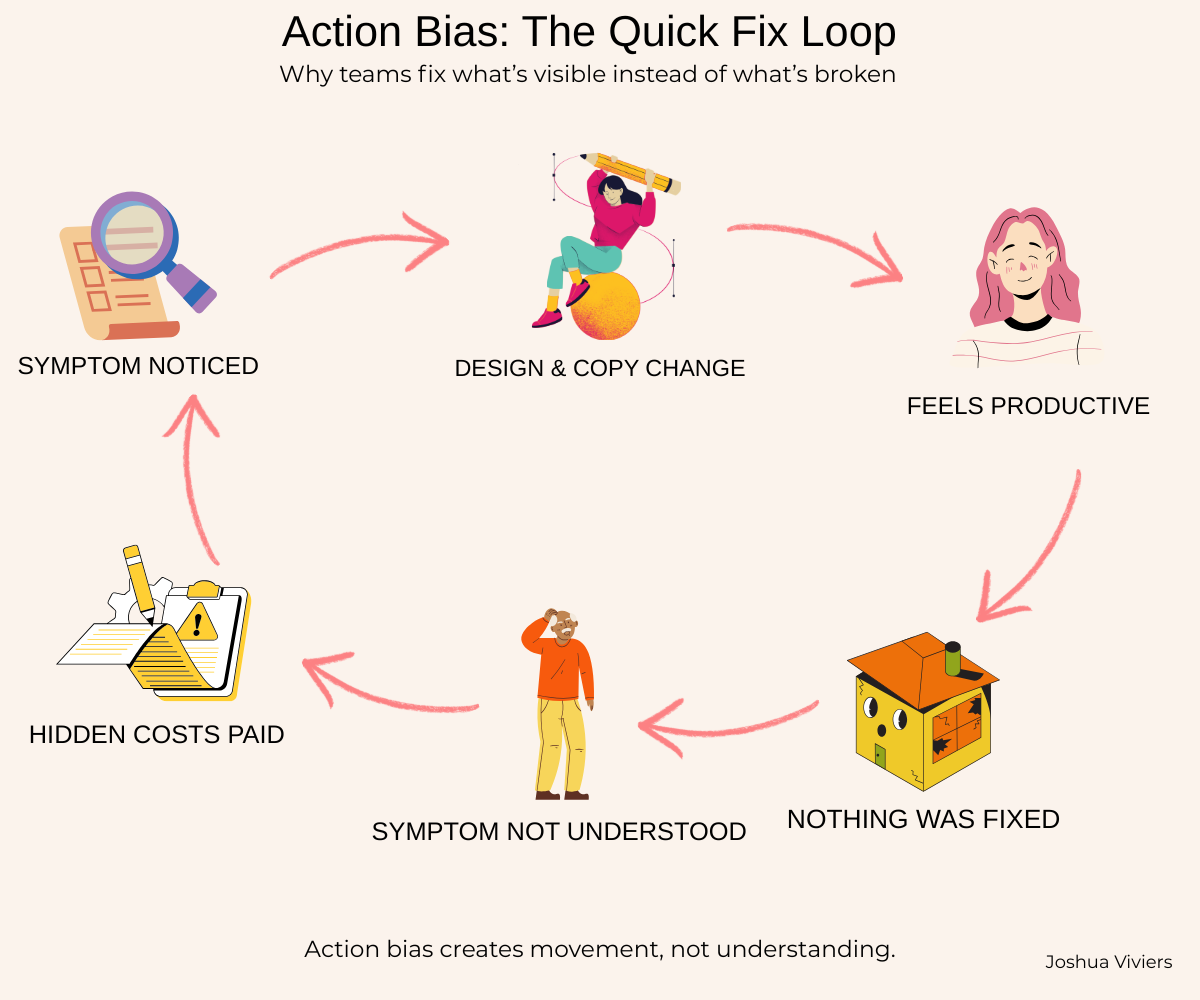
To really drive this home, let’s imagine the website as a physical storefront. You, as the owner, have noticed that conversion rate optimization has dropped dramatically. So, the first thing you do is repaint the sign (design) and rewrite the sale poster (copy). But you never considered that sales might be dropping because you are selling winter coats in the middle of the hottest summer (message-intent mismatch).
This is actually why I developed the Entry Diagnostic for websites, so you don’t try selling winter coats in summer.
Surface Fixes Feel Productive – But Rarely Change Outcomes
Let’s elaborate on the idea of Action Bias. We’ve established that the first two “fixes” are usually changing the copy and design of a site, which usually includes:
- Shortening copy
- Adding CTAs
- Tweaking colours / layouts
- A/B testing headlines in isolation
Now, don’t get me wrong, these might help and are always good to do, because you never know which small improvement might lead to big gains. But it shouldn’t be the first thing you do.
Why? Because, firstly, it acts as a confirmation bias:
- You see a high bounce rate.
- You change the copy slightly.
- The bounce rate decreases for a bit.
- You pat yourself on the back for fixing the problem.
How many times has this actually led to sustained growth? Well, because you convinced yourself you have solved the problem, and never performed an analysis on intent, signal, positioning, tone, clarity, and more, you never truly found the problem.
Which means that those small wins are actually stalling your growth. Essentially you’re optimizing for expression without examining alignment. Movement doesn’t always amount to progress.
The easiest way to think about this then is:
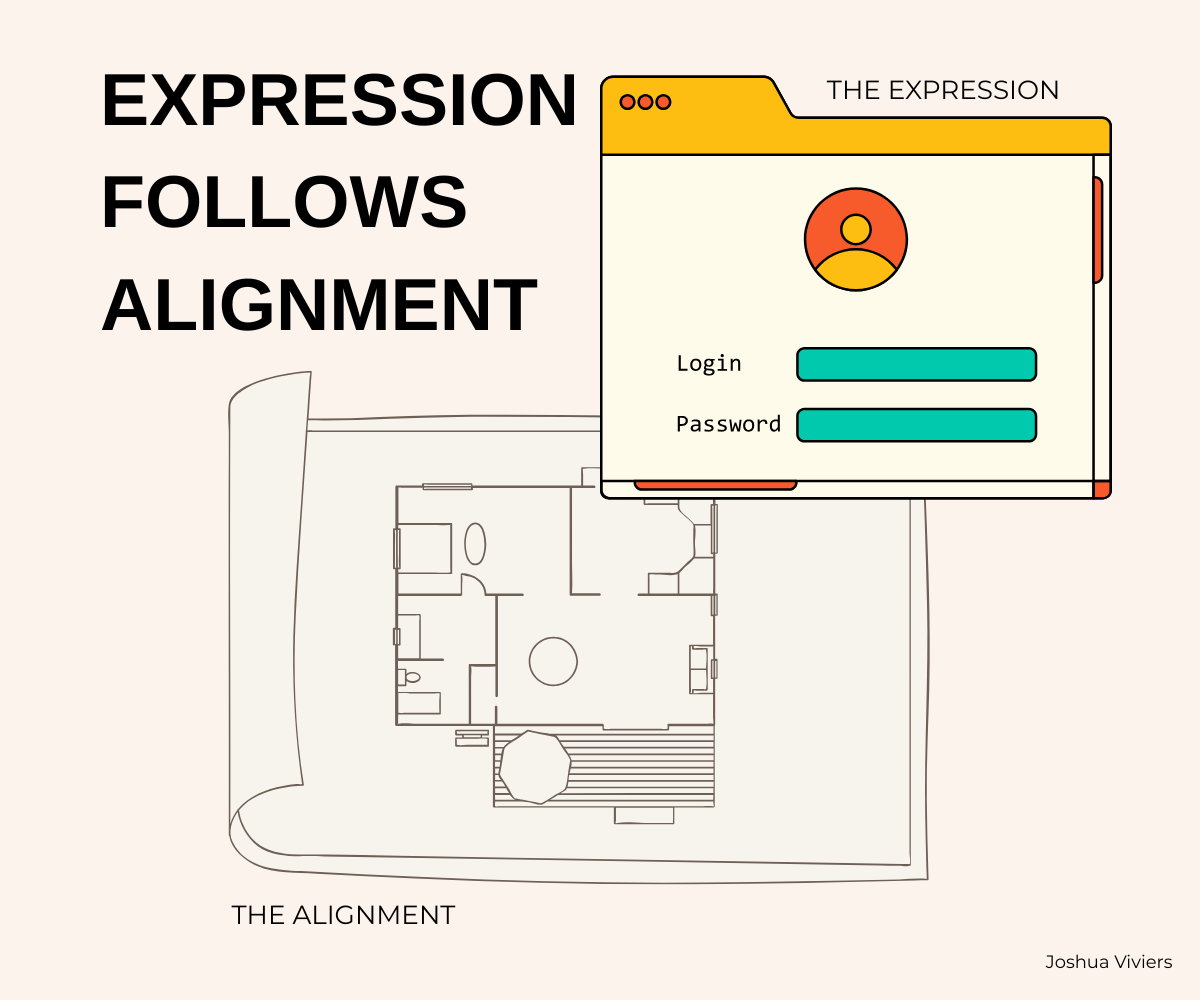
Copy & Design = The Expression of your message.
Strategy & Intent = The Alignment of your message.
The Rule: You cannot fix an alignment problem with a better expression.
Where Teams Think the Problem Is vs. Where It Actually Lives
This is the area where many teams make the biggest mistakes, because the problems are usually structural. Meaning that any surface level tweaks will not bring the results they’re looking for.
Teams usually point to a few predictable things as the problems:
- “People aren’t clicking”
- “Bounce rate is high”
- “Traffic isn’t converting”
But, those aren’t problems, those are symptoms. And like most symptoms, they can be traced back to a point of origin. For each of these symptoms, the corresponding problem is likely:
- Visitors don’t understand who it’s for
- The message doesn’t match their intent
- Trust questions go unanswered
And worse, when you apply small tweaks to your information architecture, you likely make the problem worse. For example:
- When you shorten the copy: you probably removed the context the visitor needed to build trust.
- When you add CTAs: you won’t convince the visitor to buy anything if you haven’t convinced them they need the product, and adding more CTAs will likely increase cognitive load.
- When you change designs: you might lower the bounce rate for a week or two, but it doesn’t fix your broken value proposition.
Why does this happen? Because analytics doesn’t differentiate between confusion and hesitation. And it doesn’t explain the customer journey the moment your page loads.
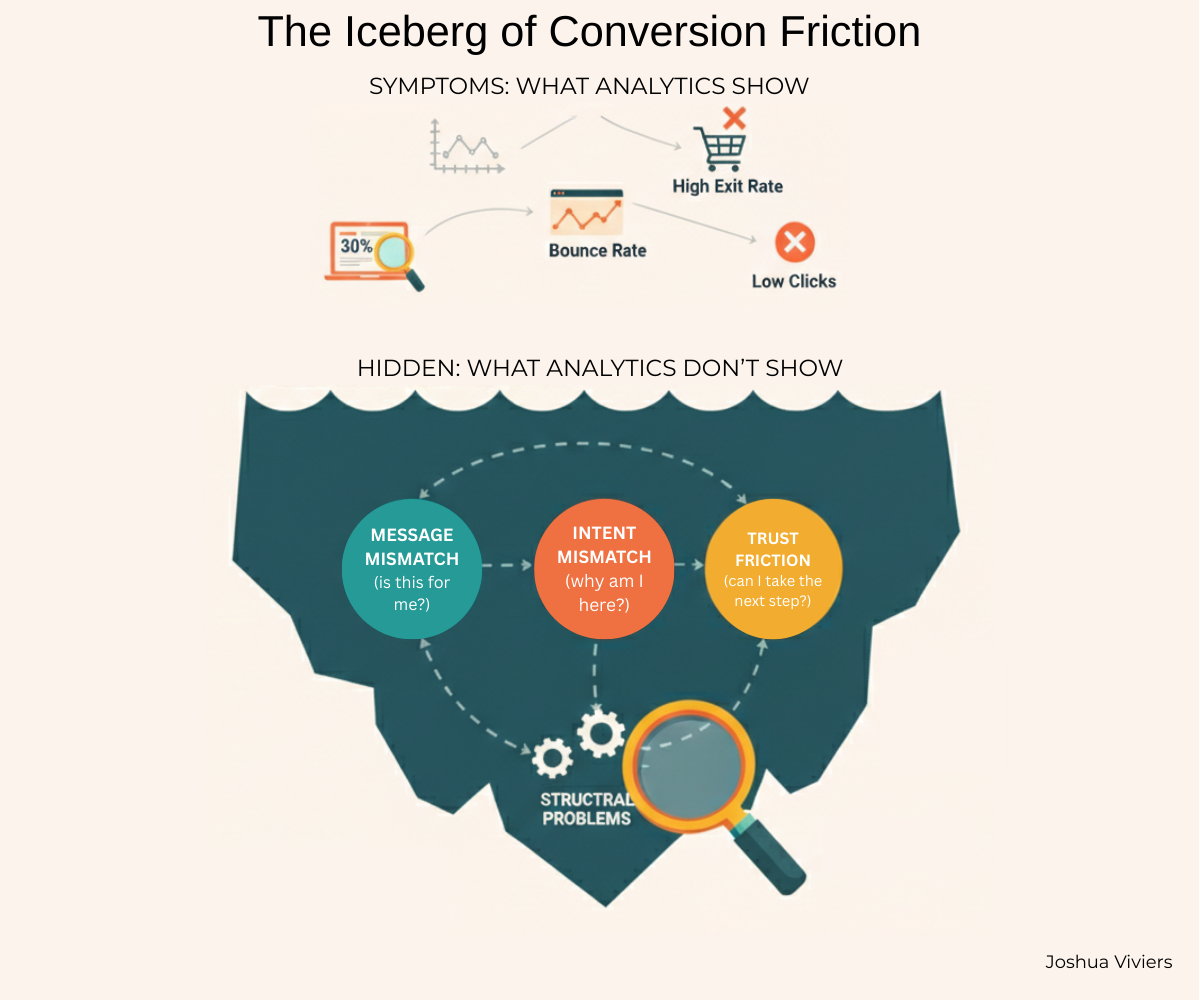
You probably know that you have 5 seconds to keep a visitor on your page. Have a high bounce rate? It’s not a “CTA optimization” problem. It’s likely that you didn’t answer the two most important questions a visitor has: “What is this?’ and “is this for me?”
Why Analytics Often Mislead Early-Stage Teams
I will admit that obviously analytics are crucial for running a successful website. I would in no way, shape, or form suggest abandoning analytics and operate purely with vibes. But, the point I am making is that analytics are incomplete. Unfortunately, they don’t paint the complete picture.
Analytics are very useful for telling you things like:
- Where users came from
- What pages they visited
- Where they dropped off
- What they clicked (or didn’t)
But, what they can’t tell you is:
- What the user expected to see
- What confused them
- What gave them pause
- What assumption broke
And that’s the “a-ha!” moment. You’ve likely now realized that analytics can point you in the direction of the symptom that is affecting your site. But, without inspection and an understanding of users, they can’t explain why that symptom exists in the first place.
With that said, it’s easier to draw conclusions when you are working with a massive sample size. Simply because trends emerge and you can begin mapping and theorizing behavior more accurately. But, if you are an early-stage team, low traffic on your website means:
- Small sample sizes
- Outliers skewing conclusions
Which also means that you are likely to:
- Draw conclusions that aren’t founded by enough statistical information
- Overreact to any small change you notice
- Gain false confidence when applying surface-level fixes
- Prematurely optimize your website
And that false positive is the confirmation bias mentioned earlier. Let’s imagine you change the color of a button and you see a 5% increase on low traffic. You’re going to feel like that’s monumental. But, that’s called “Local Maxima”: you’ve optimized a broken process to the point where it is the best version of a bad idea. What you should be aiming for is “Global Maxima”: a total change in the alignment.
The key point to take away from this is that data without context is like telling a story without an understanding.
The Three Invisible Questions Every Visitor Is Asking
So, if it’s not the copy and it’s not the design that’s the problem, what exactly is it? The first place to start is with message-intent-trust. I know that sounds complicated, but it’s actually rather simple.
When a visitor arrives at your site they want to know a few things. These things are what not only keeps them on your site, but also what determines if they will look around, and, above all hope, sign up for your service or purchase your product. And this begins with your message.
Message
Quite simply, the reader wants to know “Is this for someone like me?”. They are looking for connection to their identity and relevance, or in other words, Audience Resonance, and if you want to be more specific and technical, Ideal Customer Profile alignment. What does that include?
- Familiar language
- Recognisable problems
- Signals that say “you’re in the right place”
If they don’t see any of that, they won’t just feel out of place, they will feel unseen.
What are we targeting with this?
- Context
- Awareness level
- Intent
Intent
This is the entire reason they visited your site to begin with. Something about your brand gave them the idea you can fix their problem. So, essentially, all visitors arrive with a specific expectation of you and a general idea of a solution.
What you are aiming to do then is decrease friction so they understand if you are what they need. Friction happens when:
- The site answers a different problem
- Or jumps too quickly to outcomes without first explaining what the problem is
Why do you need to frame the problem? Because you need to show readers that you understand:
- What they are going through
- What they need
- What they want
Because you need to build trust. You wouldn’t trust someone to solve your problem if you didn’t think they understood how you feel or what the problem is, would you?
Trust
Which brings us to the final thing you need to prove: the visitor can trust you. Now, don’t take offense, it’s not about liking you. They simply want to reduce risk and are asking themselves “Can I trust this enough to take the next step?” What trust means is:
- “Will this waste my time?”
- “Will I regret clicking this?”
- “Is this more complicated than it looks?”
There are many things that can introduce friction or reduce cognitive ease in this process, but the main culprits are:
- Vague promises
- Overconfidence
- Missing context
- Unclear next steps
Here, and much like throughout the previous stages, even great copy or designs can fail. Because the copy could either be promising too much or solving the wrong problem too well.
More importantly, trust isn’t built by trying to be persuasive. It’s mostly built by being as clear as possible so the reader has very solid expectations of you.
When Combined
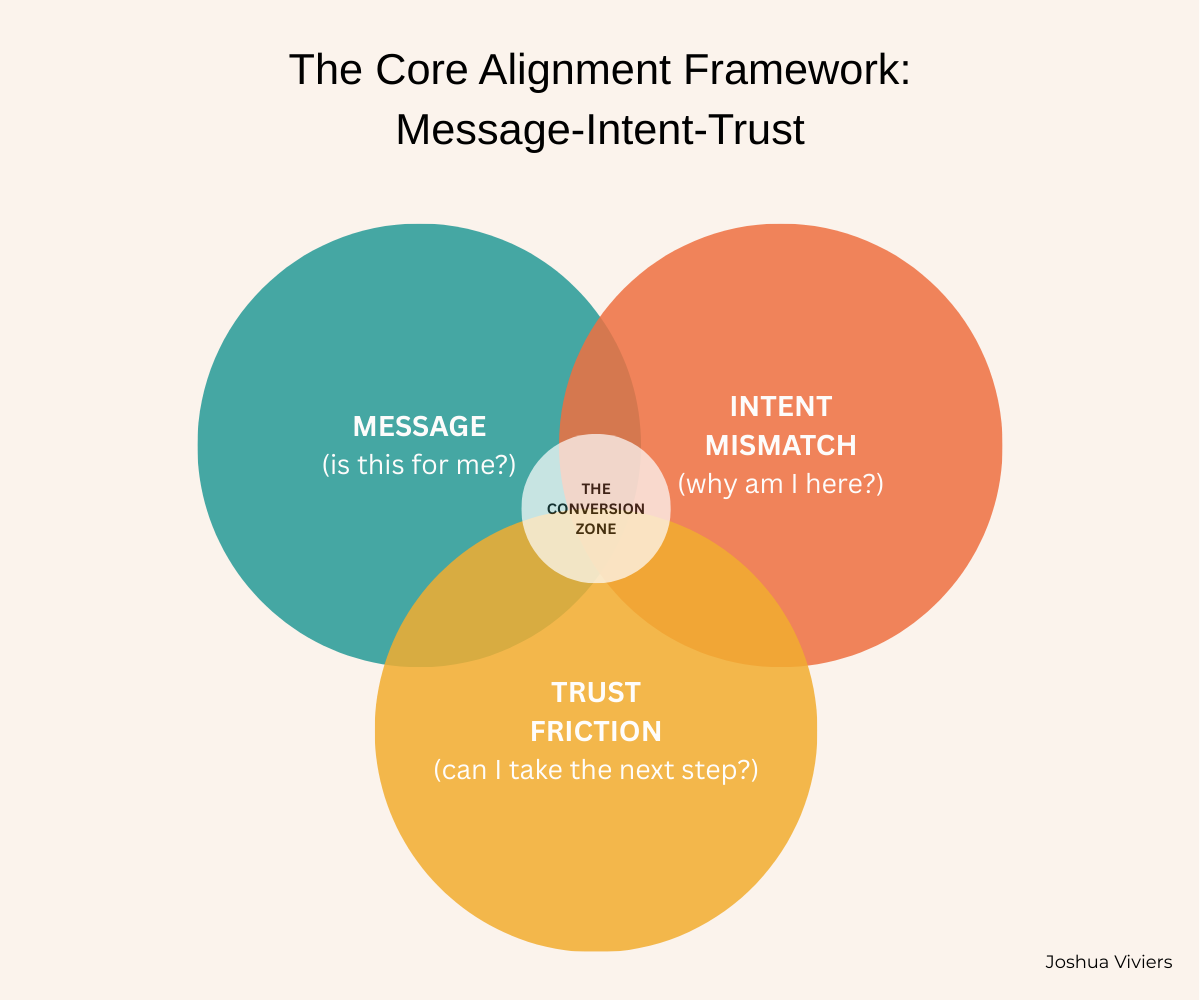
It’s crucial to understand that this process doesn’t happen in isolation: the visitor doesn’t just visit your website looking for trust. Each stage happens simultaneously. More importantly, these questions are:
- Silent
- Unspoken
- Instant
It’s also not something that users are consciously reflecting on, but it doesn’t change the fact that they decide everything. The bounce rate, the time on page, the number of pages viewed, whether they download a free resource, and most importantly, if they become a customer.
Most Conversion Problems Are Breaks in Alignment
With your newfound understanding of message-intent-trust, let’s delve into the idea of misalignment. Misalignment needs to be fixed first before you focus on execution (changing copy or design).
Message Mismatch
As you now know, every visitor arrives with a preconceived notion of a solution, which means they have an expectation. The message mismatch happens when the site says the opposite, or something different, to what the visitor needs to hear right now.
This is why it’s so important to understand your audience, who they are, what they want, what they need, what they think, and a lot more.
Intent Mismatch
Every visitor is in a different stage of the consumer journey:
- Unaware
- Problem aware
- Solution aware
- Product aware
- Most aware
The intent mismatch happens when the page they are viewing assumes they are on a different stage of awareness. This is why it’s a good idea to have multiple landing pages, especially if you have different services or products.
Your site should have a homepage, a service/product page, a page for individual services if they are quite different, and an about page, at the very least. Each page should be optimized in messaging for different stages of the consumer journey.
Trust Friction
And, as you might have guessed, trust friction happens when your pages have created too much uncertainty, or there are too many friction points, for the reader to move forward. This could range from:
- Overpromising results
- Lack of case studies
- Introducing a CTA too early
- Using generic phrases
- Not making it clear you understand the problem
- Not providing detailed steps on how you will fix the problem
Overall
If you learn anything from this section it’s that none of the mismatches listed above can be solved with “prettier words” or by enhancing your visuals. That’s like putting a fresh coat of paint on a house with a cracked foundation. You don’t need a designer to fix your conversion rate, you need someone who understands what is causing the cracks.
Why Diagnosis Comes Before Optimization
It should be pretty clear now why many brands jump to optimizing before a diagnosis. The temptation to hunt for those quick wins is irresistible. But performing a diagnosis isn’t inaction, which I explain on my audit service website. It’s just a different form of movement, one that actually informs optimization.
A diagnosis can answer:
- What’s actually happening
- Where confusion enters
- What assumptions are wrong
- What not to touch yet
Because not everything needs to be adjusted, edited, improved, changed, or fixed. Restraint could be as powerful for your website as action.
Optimization on the other hand answers:
- How to improve execution
- How to refine what’s already working
- How to scale with clear messaging and positioning
But, the step that most people miss with optimization, is that it assumes you already understand the problem.
Final Thoughts
By no means am I saying that analytics or optimization or bad. I’m saying that if you don’t know whether the issue is:
- Messaging
- Intent
- Trust
- Or something else
Then optimization is premature, and could actually end up hurting more than helping. And, if you’re not sure what is causing friction or why visitors are leaving as soon as they arrive, that’s exactly what audits are for.
