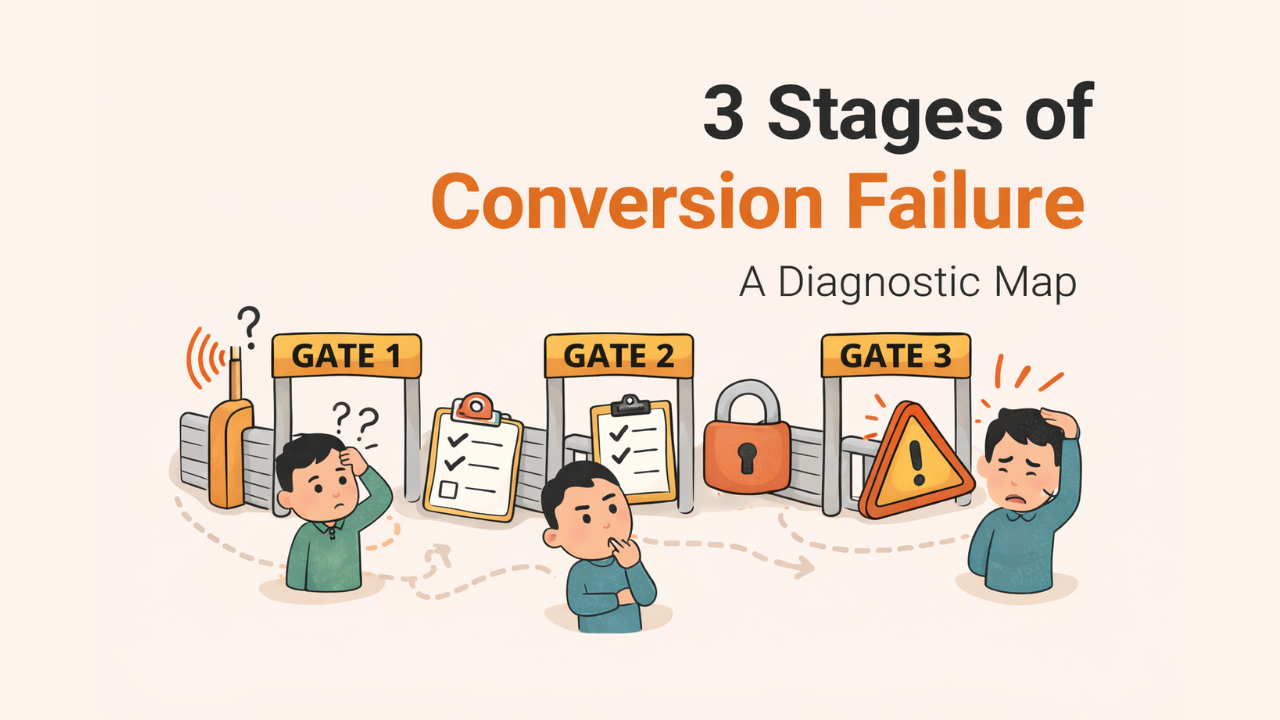
The 3 Stages of Conversion Failure: A Diagnostic Map
When a founder tells me their conversion rate is "flat at 2%," they are looking at a symptom, not the cause. A conversion rate is not a single, static number; it is a cumulative score based on three distinct, sequential hurdles.
In my diagnostic work, I see websites fail at different depths. If you are failing at Stage 1, it doesn’t matter how good your Stage 3 social proof is, no one is staying long enough to see it.
To fix your website, you must first locate where the leak is. Most founders misdiagnose their own sites because they are too close to the project to see the friction. This is the diagnostic map I use to identify exactly where your ROI is dying.
The Illusion of the "Flat" Conversion Rate
Most analytics dashboards give you a "total" conversion percentage. This is a dangerous oversimplification.
Think of your website as a three-gate security system.
- Gate 1 checks for Relevance (Signal).
- Gate 2 checks for Utility (Solution).
- Gate 3 checks for Integrity (Safety).
If 90% of your traffic is getting stuck at Gate 1, spending $10k on "Gate 3" (new testimonials or a better "About Us" page) is a total waste of capital. You aren't optimizing; you're guessing. In 2026, where AI-driven search has made user attention more fragmented than ever, a "flat" conversion rate is usually an indicator of a structural failure in this sequence.
Stage 1: The "Signal" Failure (The Identity Crisis)
The Problem: This is a failure of the 5-Second Test. Visitors land on your page and their primal brain immediately asks: "Am I in the right place?"
If the answer isn't a definitive "Yes" within seconds, they bounce. In 2026, "Signal" is the most fragile part of the chain because users expect hyper-relevance from every click. If your headline is a vague, poetic statement that sounds good in a boardroom but means nothing to a stranger, you have a Signal failure.
- The Diagnostic: Look at your bounce rates and "Time on Page." If your bounce rate is over 70% or your average time-on-site is under 30 seconds, your "Signal" is broken.
- The Root Cause: This is usually a Mirror Problem. You are talking about who you want to be instead of reflecting the specific problem the user is trying to solve. Your internal brand confusion is manifesting as a "vague" hero section.
While it’s generally understood that this test focuses on visuals, it also applies more broadly to “how your website is presented to visitors” or “how visitors perceive your website”.
Stage 2: The "Solution" Failure (The Intent Gap)
The Problem: You’ve passed the Signal test, they know what you do, but you’ve failed to create Urgency.
This is where "The Offer" comes into play. If your website is technically clear but commercially boring, you have a Solution failure. This happens when a founder understands their product but doesn't understand their customer's Intent. You are offering a "nice-to-have" to a market that is looking for a "must-have."
- The Diagnostic: You see high scroll depth (people are reading) but zero clicks on your primary Call to Action (CTA). Your visitors are becoming "educated" but remaining "unactivated." They are window shopping, not buying.
- The Root Cause: This is often a Bottleneck Problem. Your website is amplifying a weak value proposition. No amount of "copywriting magic" can fix a solution that doesn't solve a bleeding-neck problem for a specific person.
Stage 3: The "Safety" Failure (The Trust Deficit)
The Problem: This is the final, and often most expensive, hurdle. The visitor is convinced of the "What" (the solution) but they are skeptical of the "Who" (you).
In an era of "AI Slop" and anonymous, generic digital storefronts, Trust is the most expensive commodity on the market. If your site feels like a "collage of stock assets" or lacks a clear human presence, the user will feel an instinctual "Safety" alarm.
- The Diagnostic: Users visit your high-intent pages, like "Pricing," "Case Studies," or "About", and then disappear. They are doing their due diligence and finding your brand's "Mirror" to be cloudy or untrustworthy.
- The Root Cause: You lack Structural Trust. You haven't proven that you are the safe, authoritative choice. You’ve built a magician’s trick, not a credible business reflection.
The Cost of Misdiagnosis
The tragedy of modern web design is that most agencies treat all three stages as one big "Redesign" project.
They will sell you a $20k overhaul that addresses Stage 3 (better visuals) while completely ignoring the fact that your Stage 1 (Signal) is what's actually killing your business. They are fixing the curtains while the foundation is sinking.
Understanding that your website is failing is easy. Understanding at which stage it is failing requires an outside eye and a rigorous diagnostic framework.
The Self-Diagnostic Filter
Before you hire another creative, ask yourself these three questions:
- Signal: If a stranger saw my homepage for 5 seconds, could they tell their boss exactly what I solve?
- Solution: Does my offer solve a "bleeding-neck" problem, or am I selling a vitamin?
- Safety: If I were the customer, would I trust this brand with my credit card based on this site alone?
If you can’t answer those with a 100% "Yes," you have a diagnostic problem.
The Diagnostic Roadmap
I don’t offer "redesigns" because I don’t believe in guessing with your budget. I offer a 60-minute Diagnostic Call to find exactly which of these three stages is the bottleneck in your business.
We don't start with colors or fonts. We start with the Message–Intent–Trust chain. You’ll walk away with a clear understanding of why your traffic isn't turning into revenue and a Diagnostic Roadmap that outlines exactly what needs to change.
Stop fixing the symptoms. Let's find the cause.
