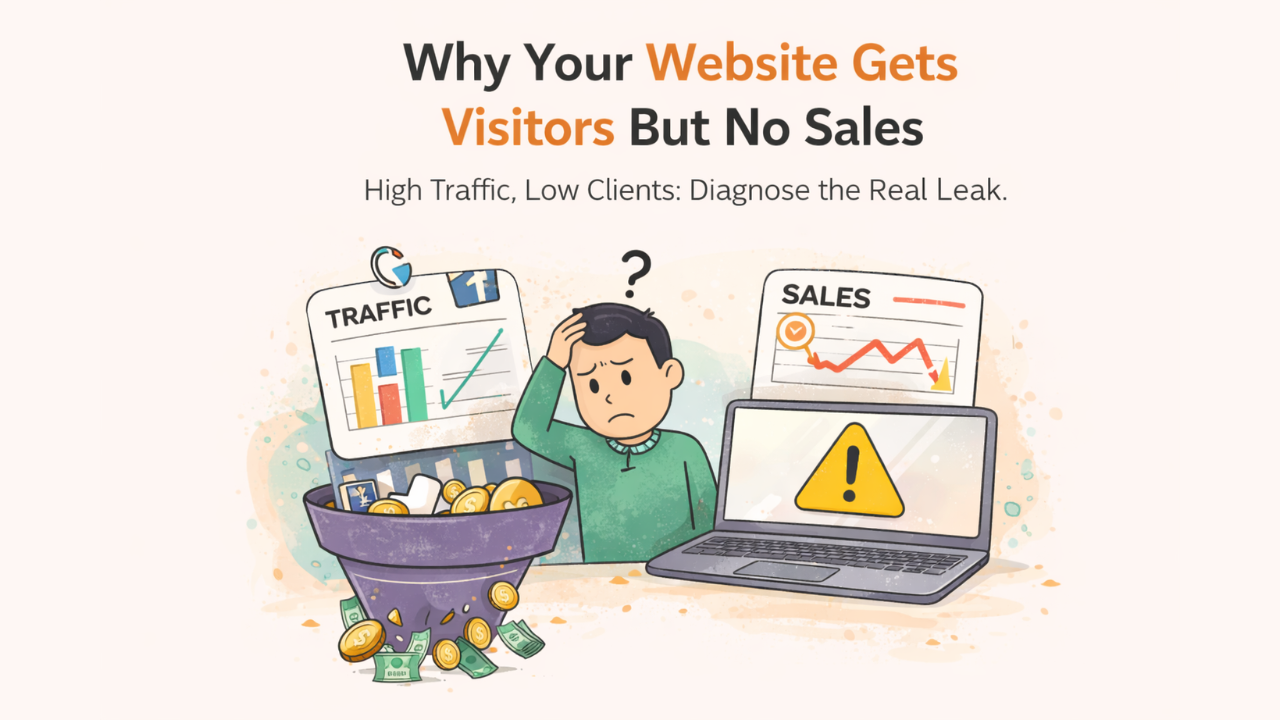
Traffic feels like progress. Sales feel like validation.
When you have one but not the other, it’s easy to feel like you’re shouting into the wind. You check your analytics, see the steady climb of sessions, and wait for the notifications that never come. The instinctual response is usually a panic-pivot: You lower your prices, you change the button colors, or you double the ad budget, assuming that if the fire isn't hot enough, you just need more wood.
But here is the hard truth: low website sales with steady traffic is a diagnostic problem, not a design problem.
If your website isn’t converting visitors into sales, you don’t have a traffic problem. You have a signal problem. You are successfully buying attention, but you are failing to convert that attention into Intent.
1. The Real Issue: Visitors Don't Equal Buyers
In the digital economy, we often confuse visibility with viability. Getting visitors to your site simply means that an algorithm (Google) or an ad platform (Meta) thinks you are relevant enough to click.
However, getting a sale means a human being has decided you are necessary.
There is a vast, expensive gap between Attention and Action.
- Attention: They saw your ad or search result.
- Intent: They believe you might have the answer to their specific pain.
- Action: They trust you enough to part with their capital.
If your website is "busy but broke," it’s because you are successfully capturing attention but losing the human at the Intent or Action phase. You are winning the battle for the click but losing the war for the wallet. Scaling your traffic at this stage doesn't solve the problem; it just increases the friction.
2. The 4 Real Reasons for Website Conversion Failure
When I perform a website conversion diagnostic, the "leak" almost always falls into one of these four structural flaws.
A. Your Message Doesn’t Match Their Intent
This is the most common cause of a low website conversion rate. It happens when there is a "scent" mismatch between the source of the traffic and the destination.
If your LinkedIn post or Google Ad promises a specific solution to a specific pain (X), but your homepage greets them with a vague, corporate mission statement about "holistic excellence" (Y), the visitor’s brain registers a "False Start." They don't stay to investigate. They leave.
If you want to solve why your website isn't converting, you must ensure that the "Mirror" they see on the landing page is an exact reflection of the "Intent" that brought them there.
B. Your Offer Isn’t Strong Enough
You might have a beautiful website and clear copy, but if you are selling a "nice-to-have" in a "must-have" economy, you will struggle.
Most founders spend their time explaining Features (what the product is) while the customer is looking for Relief(what the product does for their bleeding-neck problem). If your offer looks identical to your three closest competitors, but you’re charging 20% more because of your "process", you don't have a website problem. You have an offer bottleneck.
C. You Create Curiosity, But Not Clarity
"Clever" headlines are the enemy of conversions.
If your hero section uses "boardroom poetry" to describe your services, you are forcing the visitor to do the work of figuring out what you actually do. Research shows that if a visitor can't categorize your business within five seconds, their anxiety rises and they exit.
This is why the 5-second test is the most lethal diagnostic tool in my kit. If you create curiosity without providing immediate category clarity, you aren't being intriguing; you're being expensive.
D. There’s No Psychological Safety
Even if they want the solution and understand the offer, they might not trust you to deliver it.
In 2026, "AI Slop" and anonymous digital storefronts have made buyers hyper-skeptical. If your site lacks specificity, real-world proof, or a clear "stakes" (what happens if they don't buy), the visitor will feel an instinctual "Safety" alarm. They aren't leaving because they don't want the product; they are leaving because you haven't proven you are the safe choice.
Think of it in terms of risk awareness and risk reduction. If you highlight the risk of not using your product or service, you show the visitor you understand their problem. This in turn reduces their perceived risk in trusting you; risk reduction.
3. Why More Traffic Makes It Worse
This is the "Executive Trap." When sales are low, the boardroom usually calls for more "Lead Gen."
But if your website conversion rate is structurally broken, more traffic is a liability, not an asset. Scaling confusion does not produce a solid foundation; it produces higher ad spend.
If you are currently experiencing poor website conversions, doubling your traffic will only:
- Burn your budget faster.
- Skew your data with "unqualified" noise.
- Frustrate your sales team with low-intent leads.
Before you buy more attention, you must ensure your "Mirror" is capable of reflecting it.
4. The Diagnostic Shift: Where is the Leak?
Instead of asking, “Should I redesign?” or “Should I run more ads?”, the high-level founder asks: Where is the leak happening?
In my Signal–Solution–Safety framework, we look for the specific point of failure:
- Signal: Do they understand what this is within 5 seconds? (If no, it’s a Messaging problem.)
- Solution: Do they see why they need this right now? (If no, it’s an Offer problem.)
- Safety: Do they trust that you are the one to solve it? (If no, it’s a Trust problem.)
The Verdict: Diagnosis Before Optimization
Visitors don’t buy because something is unclear, unnecessary, or unsafe. And none of those problems are solved with a higher ad budget or a "prettier" font.
If your website has visitors but no sales, stop looking at the traffic and start looking at the reflection. Your website should be a mirror of your brand’s clarity. If that mirror is cloudy, the market will always look elsewhere.
If you’re ready to stop guessing and start correcting, you need a diagnosis, not a redesign.
